
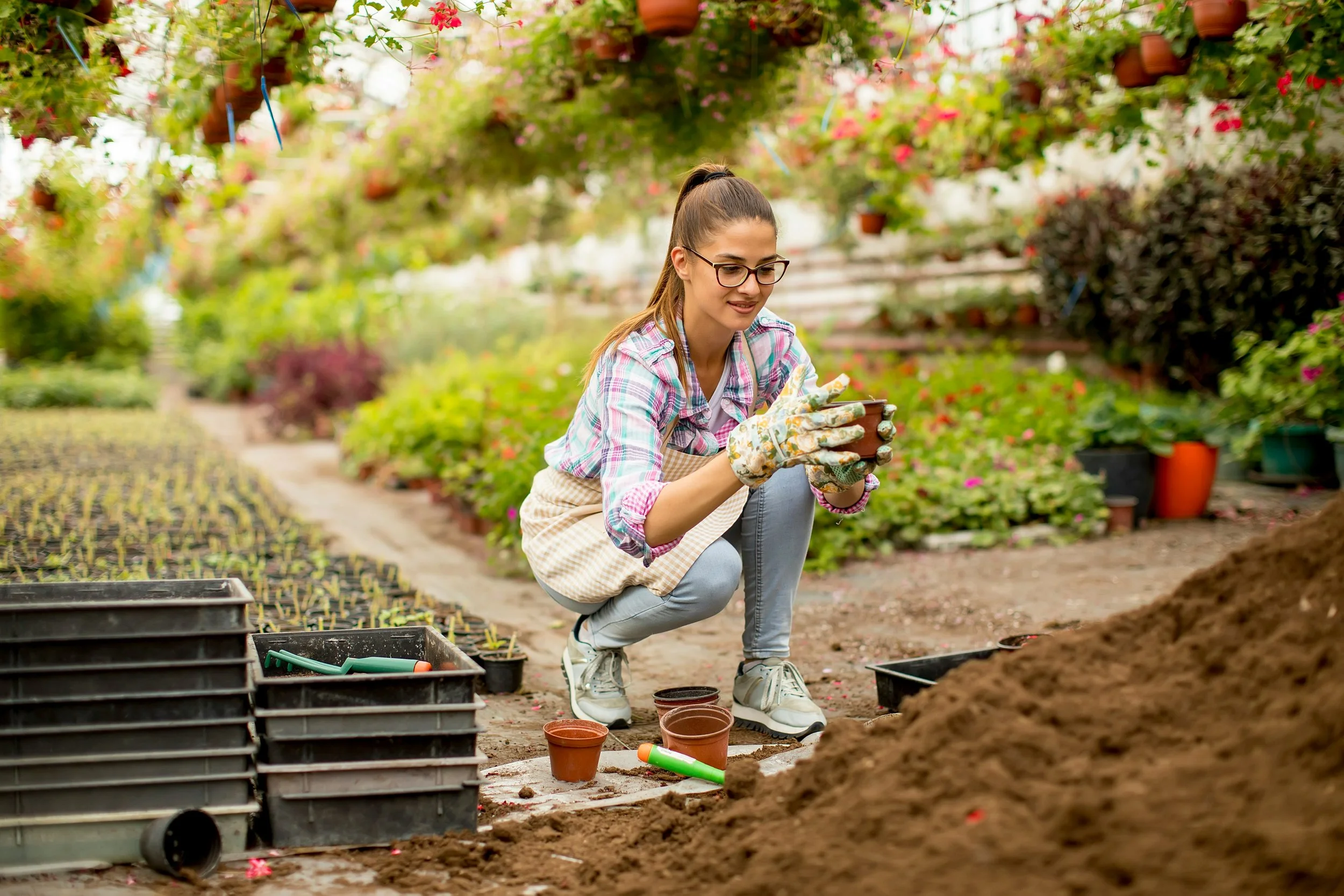
Woman planting in her indoor garden/greenhouse.
We’ve all been there.
As a new gardener, you may know this feeling all too well: You’re excited to plant your very first flowers, trees or shrubs. At first, everything looks fine. Then days pass…and suddenly the leaves start wilting. Colors fade. Plants look stressed, or worse, they die altogether.
You’re left standing there, confused and discouraged, asking yourself:
What did I do wrong?
Was I supposed to water more? Or less?
Did I fertilize too much? Not enough?
Is this spot too sunny? Too shady?
You thought gardening was simple. You dig a hole, plant it, and let nature do the rest. So, you try again. And again. And again. Eventually, that little voice creeps in: “I just don’t have a green thumb.”
Here’s the truth: that couldn’t be farther from reality.
Every single person has the ability to be a successful gardener. Gardening is not a talent you’re born with—it’s a skill you learn. Just like cooking, painting, or playing an instrument, it takes:
Passion
Knowledge
Practice
With time and experience, confidence grows—and so does your garden.
My First Gardening Failure (and What It Taught Me)
I know this because I’ve been exactly where you are.
Many years ago, when I was brand new to gardening, I decided to start growing flowers from seed. Looking back now, I laugh and think: What was I thinking!? As a beginner, I unknowingly chose one of the most challenging ways to garden. Some flower seeds are easy to grow, while others require very specific conditions. At the time, I had no idea.
I ordered seed packets from Park Seed (I don’t even remember which varieties). When they arrived, I was thrilled. I bought seed-starting soil, trays, and jumped right in, convinced I’d have beautiful flowers in no time. I followed what I thought were the instructions on the seed packets.
They said to cover the seeds and place them in a cool, dark location
So, I took the instructions literally. I covered the trays with plastic wrap and a blanket, then put them in a dark closet. After a few weeks, nothing germinated. Instead, fuzzy white mold appeared everywhere. I was completely stumped and I threw everything away.
Later, I realized my mistake. The instructions meant to cover the seeds with soil, not plastic and blankets (duh!) and provide darkness, but also airflow. A cool basement might have worked. A warm, enclosed closet definitely did not. I felt so foolish, but now I laugh at how clueless I was as a beginner. And that experience taught me an invaluable lesson: mistakes are part of learning.
A Real-Life Example: Knowledge Changes Everything
Another lesson came years later when I was installing gardens for clients.
I visited a new customer who had recently retired and taken up gardening as a hobby. He was passionate and proud of his plants, excitedly walking me through his yard. Then he pointed to several newly planted conifer trees and asked why they were turning brown.
After taking a closer look, I noticed several issues. The trees were planted too shallow, the planting holes were too narrow, the feeder roots were exposed above ground, the surrounding soil was compacted clay and rock, the area lacked full sun, and the trees were not being watered consistently.
When I asked about watering, he said, “I’m just letting Mother Nature take care of it.” This wasn’t neglect. It was simply inexperience. He also proudly showed me a sunflower planted in full shade and a vegetable garden cart placed without enough sun. With a little guidance, I explained proper planting depth and spacing, the importance of consistent watering and the difference between sun, part sun, and shade. I gave him clear instructions for caring for his garden and about a month later, he sent me photos.
Everything was thriving!
Not because he suddenly developed a “green thumb”, but because he had the right knowledge.
Why Most New Gardeners Struggle
Through my own beginner mistakes and experiences with clients, I realized something important. Most new gardeners don’t fail because they’re bad at gardening. They struggle because they’re missing basic guidance. To help eliminate overwhelm and frustration, I created what I like to call my “Baby Step” list for beginner gardeners.
The Beginner Gardener “Baby Step” List
1. Start Small
Don’t try to do everything at once. Begin with a small garden area, choose low-maintenance plants, and look for plants labeled as adaptable or easy to grow. This helps reduce overwhelm and builds confidence early on.
2. Read the Plant Label Carefully
Plant labels are your best friend.
Pay attention to:
Sun requirements (full sun, part sun, shade)
Water needs
Planting plants with the same planting requirements makes all the difference.
3. Choose Fewer Plant Types with Similar Needs
Keep maintenance simple. Start with 2–3 different plant varieties, make sure they all need the same sun and water conditions, plant them in odd-numbered groupings (3, 5, or 7) throughout your garden/landscape, and make sure they are planted in areas of your landscape that contain the required sun/shade conditions it needs.
This creates a cohesive look and makes care easier.
4. Expand as Your Confidence Grows
Once your plants are thriving:
Add new varieties
Experiment gradually
Learn from what works
Gardening is a journey. Don’t rush it.
Final Thoughts
Gardening can feel overwhelming when you’re just starting out, but it doesn’t have to be. With passion, knowledge, and a little experience, anyone can create a thriving garden. So, if you would like to take this a step further, learn more and you’re ready to stop guessing and start gardening with confidence, I created a step-by-step solution just for you.
The Beginner’s Blueprint: Top 10 Essential Steps to Create a Thriving Garden Bed from Day One walks you through what to do, from plant selection, fertilizer, soil to proper placement and so much more, so you can avoid costly mistakes and finally grow a garden that thrives!
Your dream garden isn’t about luck. It’s about knowing the right steps to take. 🌱